Poor Mourner. A song history out of my head. (Almost.)

You Shall Be Free (When the Good Lord Sets You Free.) You Shall. We Shall. I Shall. (but the struggle continues anyway.). Oh, Monah!

This song, and the way it and its derivatives wind their way through the history of all forms of American music, has been a fascination and ongoing study for me for some time now.

It’s somewhat uncertain and possibly unknowable origins go back to sometime in the 19th Century somewhere. It first entered my consciousness in my early teens by way of one of those sublime drunken Folkways sessions with Woody Guthrie in the company of Leadbelly, Sonny Terry and Brownie McGee, Cisco Houston and others. It probably got to Bob Dylan the same way, though just a couple years earlier since he’s eight years older than me. But, it had been around a lot before then.

Some of the oldest versions feature an unfortunate, especially when done by certain white folks later, use of the “N” word. But the minstrel shows were the basis of American Pop Music, its history doesn’t make any sense without that link. By the time Woody was doing it, and long before, that word had been substituted with Preacher. Not a euphemism, but a whole shift in perspective.

Before the long existence as a humorous song, though, it may have had ‘spiritual’ origins. Some verses may have been published in the 1840s, but who knows where it had been before publication.

The first recording linked below is of intense interest, having only been discovered very belatedly. In, I think, the 1990’s. It dates from 1898, and is widely thought to be the first recorded example of ‘Vernacular African American’ music. Before that all history is written word and inference. After that, recording of Black Americans remained spotty due to lack of commercial and majority culture interest. (even the first blues and jazz records released in the early 20s were by white or sort of white folk.)

Maybe 1898 seems kind of early, but ‘Stars and Stripes Forever was already a big hit record in 1895. This may be a hard listen for contemporary ears, especially those that haven’t been trying to make their way through the noise and limited range and dynamics of acoustic recording techniques on very early records for the majority of their lives. But, I recommend it most highly, not only for the historical importance but the aesthetic brilliance and peculiarity amongst more popular fare. The less ‘classical’ solo banjo with two voices, tempo shifts, exuberant expressive voices; all sounds from out of nowhere. This particular reissue may err a bit on the side of noise reduction vs. full spectrum.

Before this the earliest black voices to be heard were the vocal Quartets, like the “Dinwiddie Colored Quartet” who released their version in 1902. The first of these groups to gain popularity were associated with colleges. They had a much more restrained and ‘classical’ approach and their repertoires leaned heavily on published ‘spirituals’, though many delved into the comic song also.

Things get really interesting (and more accessible at the time) for the ’60s roots music enthusiast with the 1927 Paramount release of “You Shall” by the incomparable Frank Stokes . Stokes was a powerful voiced Memphis street singer and recording star whose repertoire straddled the older traditions and the contemporary music, The Blues. He may, some think, be the source of some of W.C. Handy’s published works. His voice was so strong they had some difficulty balancing it with the guitar. Or, two guitars when he recorded with his partner Dan Sane as the Beale St. Sheiks. The flip side is kind of the same song with even longer holds on the V chord and even more scandalous lyrics, “It’s a Good Thing”. (about having a lot of women.)

It pops up in the Old Time Country string band realm as “When the Good Lord Sets You Free”, also from 1927, by the Carolina Tar Heels. They were different from most string bands, featuring harmonica by “Doc” Walsh in place of a fiddle. This group included Clarence “Tom” Ashley who recorded a solo banjo version of The Cuckoo that showed up on the Harry Smith Folkways Anthology and inspired a million covers. It was his rediscovery in 1961 that lead directly to the emergence of Doc Watson. Clarence didn’t have a banjo at the time and he said, “well, there’s a young fellow down the road knows all these old songs…” Except, Doc only had an electric guitar at the time. They fixed them both up with new instruments and took them off to L.A. to play at the Ash Grove and the rest, as they say,…

Then there’s the aforementioned Woody et al. version. I don’t know whether he got it off of a hillbilly record or Frank Stokes or just an acquaintance. He may have added some more floating verses and made some of his own.

Which brings us directly to Bob Dylan, who recorded it twice with new lyrics of his own. No doubt a couple people heard those versions.

But before that there was an anomalous detour into a rewritten version by Ted Weems and Joe “Country” Washburn “Oh, Monah!” which became a HIT in 1941. It was also done by countless Western Swing and country and bgrass bands and British big bands and maybe even an Australian folk-rock band in the ’60s.

Pete in ’63

This is just a little promo video for this amazing concert video I watched last night. Well, this morning actually. I suppose I should have taken a break in the middle and gone to bed around sunrise but I got caught up. This is Pete at what I think of as a peak for him. He was just beginning to become one of the biggest influences on my life, although almost entirely excluded from American media. He had only recently had his Federal prison sentence for contempt of Congress commuted. I was starting to hear his concerts through Folkways records I found in the basement of the Grandview Library, along with copies of the hard to find Sing Out! magazine in which he had a regular column called Johnny Appleseed, Jr. A new contract with Columbia Records, his first major label since the Weavers got blacklisted in the early ’50s while they were top of the hit parade, resulted in a great Carnegie Hall concert recording from this same year, but I never imagined there would be a way to actually see him performing. At the time he was blacklisted from the TV show named after a phrase he and Woody had made popular. I wonder how it would have affected me at 13 to see him as a human rather than just a disembodied voice and some dramatic still photos. Standing alone in the middle of 3,000 people who sing along reluctantly, and for some apparently cynically, at first; but by the end transformed into an emotional choir. He closed his show, before encores, with a song by “a young friend” of his, Bob Dylan. (Pete was a member of The Old Guard of folk music, 44 years old here.) “A Hard Rain…” Bob’s own record of it had barely been released when Pete did it at Carnegie Hall, and I don’t think it was being heard that much yet. If people knew of Bob at all, it was as a guy who wrote some Peter, Paul and Mary hits, but sounded too funny to actually listen to. It was interesting to see that Pete was still using crib notes on it here. He wasn’t reading it, no music stand nonsense, but you can see him glancing down at his feet between lines to check what came next.

One thing that weirdly stuck out to me, having had my ears ruined by the age of electronic tuners, was that he was never quite in tune through the whole concert. He would take a few seconds to tune, usually not the string that I was noticing was bad, but he didn’t obsess about it. Went from Drop D to standard on the 12-string, kept moving the capo up and down sometimes in the middle of a song when he decided it was not in the best key for everyone to sing, and therefore having to change the 5th string on the banjo. It seemed so obvious to me during the brief attempt at tuning that he hadn’t got it. But, he just charged right on, and once he got going it really didn’t matter a bit.

That studio clip where he is chopping the log was during a long segment on some TV show devoted to a salute to Leadbelly. After he finishes chopping through the work song, he looks up at the camera and says “Well that’s a ridiculous thing to do on TV, isn’t it? It doesn’t belong on a screen! Well, face it, folk music doesn’t belong on a stage, either.” Then he goes on and chops along to a film of Leadbelly doing “Take This Hammer.”

It’s just such a fascinating contradiction how he continually had massive success in industries he considered essentially wrong, and made a virtue of it.
Happy Birthday, Pete

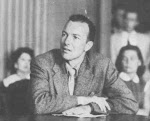
Pete Seeger, 90 years old today. His generation (including my parents) seem to have the market on longevity (while my generation is dropping like flies, already); but not even that many of his fellow WWII survivors were out standing upright and playing the banjo in the freezing cold of this year’s January. Let alone doing it in front of the President-elect, in the city that tried to throw him in jail 55 years earlier.
Pete testifying:

The testimony:

http://www.peteseeger.net/HUAC.htm

Here’s one place playing some music for the occasion:
http://www.downhomeradioshow.com/2009/05/pete-seeger-turns-90-happy-birthday/
I don’t have the time or strength to write the book on Pete right now. Heck, that would mean catching up with what he’s been up to, when there’s no one who could even keep up with him. There was a very nice biography on him broadcast on PBS last year, and it showed me many things about his life I had either never heard or forgotten over the years. I guess he never much focused on telling us his own story, except as it related to his telling of other people’s stories, and their telling of their own. By the end of the movie, I was saying, “I take back any of the nasty things I’ve had to say about Pete over the years.” Not that I ever stopped being his fan, but I certainly saw some weaknesses between when I got into the whole earlier folk movement in my early teens, and when I learned so much more about the more rootsy original versions that inspired it. Not that I would take kindly to any ignorant punk putting him down. But, sure, Pete’s blues weren’t that bluesy. His easy-going approach to other languages turned ‘mbube’ into ‘wimoweh’ in most of the world’s mind. he would choose ideology over aesthetics repeatedly.
Still, I see now, he is authentic as any of those sources. He has been the most whatever the heck he is that anyone could possibly be. He got every drop out of it. Unflagging effort, unsullied virtue, untiring seeking and sharing. Love, peace, justice, universal brotherhood of man. School drop-out, hobo, protester, cabin-building rural independant… if it weren’t for his shunning of drugs, alcohol and free sex he would indeed be the prototypical hippie.
One of the most amazing and mysterious things about his history is his effect on popular culture. he has spent most of his life not only not pursuing fame and commercial success, but attacking the very concepts. And yet, he keeps coming back to the ‘top of the charts’ decade after decade. Talk about the weeds cracking the sidewalk.
I guess there should be some mention of the star-studded spectacular, though I’m not that hot on it. He’s spending tonight at Madison Square Garden with Bruce Springsteen and Eddie Vedder, etc. and certainly not that happy at the prospect. “I’ve already had too much publicity”, he says. But, it’s going to raise a lot of money for his pet project of keeping a sloop sailing the Hudson, raising awareness for its’ cleanup. He had this idea a long time ago; and it happened.