Category: music
r.i.p Noah Shull
so, I said to my cat, (instead),
no I’m not mad at you;
yes, you can live here, that’s just fine;
you stay with me, you and all the spirits.
Maybe I could have said that to Noah
Maybe I could have said that to Pete
Maybe they would have been too much for me to handle, let alone help;
but what good am I if not the last refuge of the lost musicians
who kept washing up on my
sure
If not the one who brings the bad trippers out and down
Pete, Noah, Chris… well, I did harbor Pearcy for some time, years ago. But, then I didn't.
Why couldn’t I take them all in, and work the magic
write the magic words on the magic almonds
that transfer the people’s disease into me
and then I just shake it off, like I do.
See me shaking? yeah, it will be over soon.
Shaking it right off.
So I had a rough decade or so after allegedly saving that last tripping stranger’s life.
I’m sure it was just a coincidence.
probably.
Maybe I did, just now, say it
to all of them, all the spirits
in or around the cat.
The cat is trying to speak for all, he says.
Is that what he said? I keep getting it all wrong.
All right. Alright.
Oh, Glory. Glory, Glory. All Glory, all the Time
time, time
‘Oh, Glory’
Pete in ’63
This is just a little promo video for this amazing concert video I watched last night. Well, this morning actually. I suppose I should have taken a break in the middle and gone to bed around sunrise but I got caught up. This is Pete at what I think of as a peak for him. He was just beginning to become one of the biggest influences on my life, although almost entirely excluded from American media. He had only recently had his Federal prison sentence for contempt of Congress commuted. I was starting to hear his concerts through Folkways records I found in the basement of the Grandview Library, along with copies of the hard to find Sing Out! magazine in which he had a regular column called Johnny Appleseed, Jr. A new contract with Columbia Records, his first major label since the Weavers got blacklisted in the early ’50s while they were top of the hit parade, resulted in a great Carnegie Hall concert recording from this same year, but I never imagined there would be a way to actually see him performing. At the time he was blacklisted from the TV show named after a phrase he and Woody had made popular. I wonder how it would have affected me at 13 to see him as a human rather than just a disembodied voice and some dramatic still photos. Standing alone in the middle of 3,000 people who sing along reluctantly, and for some apparently cynically, at first; but by the end transformed into an emotional choir. He closed his show, before encores, with a song by “a young friend” of his, Bob Dylan. (Pete was a member of The Old Guard of folk music, 44 years old here.) “A Hard Rain…” Bob’s own record of it had barely been released when Pete did it at Carnegie Hall, and I don’t think it was being heard that much yet. If people knew of Bob at all, it was as a guy who wrote some Peter, Paul and Mary hits, but sounded too funny to actually listen to. It was interesting to see that Pete was still using crib notes on it here. He wasn’t reading it, no music stand nonsense, but you can see him glancing down at his feet between lines to check what came next.
One thing that weirdly stuck out to me, having had my ears ruined by the age of electronic tuners, was that he was never quite in tune through the whole concert. He would take a few seconds to tune, usually not the string that I was noticing was bad, but he didn’t obsess about it. Went from Drop D to standard on the 12-string, kept moving the capo up and down sometimes in the middle of a song when he decided it was not in the best key for everyone to sing, and therefore having to change the 5th string on the banjo. It seemed so obvious to me during the brief attempt at tuning that he hadn’t got it. But, he just charged right on, and once he got going it really didn’t matter a bit.
That studio clip where he is chopping the log was during a long segment on some TV show devoted to a salute to Leadbelly. After he finishes chopping through the work song, he looks up at the camera and says “Well that’s a ridiculous thing to do on TV, isn’t it? It doesn’t belong on a screen! Well, face it, folk music doesn’t belong on a stage, either.” Then he goes on and chops along to a film of Leadbelly doing “Take This Hammer.”
It’s just such a fascinating contradiction how he continually had massive success in industries he considered essentially wrong, and made a virtue of it.
All singing, All dancing Moving Picture Show
Four Songs. Movie by Barry Chern
porch song
Lili Boule de Gomme
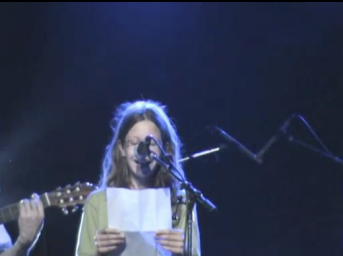
This was the other song that Jean-Paul Boissard wrote out for me during the Columbus stop-over on his seeing America trip in the ’70s. My attempt at a singable English version did not get as far as with J’ai Mis le Feu, but I still retain a fair sense of the meaning. Maybe someday. The narrator is a young woman who has different identities in the different verses, all having to do with movie idol fueled fantasies. It starts out with her as Lili Boule de Gomme, (Lili Gumball, or Bubble-gum.) “I’m 13 but I look 20.” Then she is Brigitte Boule de Gomme (“I’m 20, but I don’t look it”), then Marylin Boule de Gomme (“I am dead, but I never age”).
Here is one of several videos of a Paul Boissard tribute concert at his home club in Picardy, about 10 years ago. Lili appears at about 16:45. Here it was sung by a young girl, which made it extra poignant. She didn’t really get older as the song went on, though. Then everyone starts singing along at the end. This brings tears to my eyes every time. I used to think I might be the only person in the world that knew this song. Everyone knows this song.
Regarder la vidéo «20 ans dans la lune 1» envoyée par François sur dailymotion.
And here’s a recording of Paul
(lyrics:) Je m’appelle Lili boule de gomme J’ai treize ans mais j’en parais vingt D’ailleurs l’âge ça ne compte pas Au fond des salles de cinéma Je m’appelle Lili boule de gomme J’aime les hommes qui ont des gros bras Des moustaches comme mon papa Et qui m’emmènent au cinéma Quand arrive l’entracte Et qu’ils me payent un esquimau Mes rastacouères rougissent de trac Et je leur dis ces tendres mots Je m’appelle Brigitte boule de gomme J’ai vingt ans mais je les parais pas Du talent comme on n’en fait pas Et je veux faire du cinéma Je m’appelle Brigitte boule de gomme Et je danse souvent les pieds nus Dans la chambre pleine d’inconnus Que je rencontre au cinéma Je suis le monstre de ma voisine Quand je chante avec mes héros Et que je joue la fin du film En leur disant ces tendres mots Je m’appelle Marylin boule de gomme Et je me tourne dans les draps D’une nuit qui ne finit pas A la sortie du cinéma Je m’appelle Marylin boule de gomme Je suis morte mais je ne vieillis pas Dans le film quand je dis aux soldats Je vous en prie n’y allez pas Ils vous tueront tous là-bas Restez encore auprès de moi.
Finding and losing an old friend.

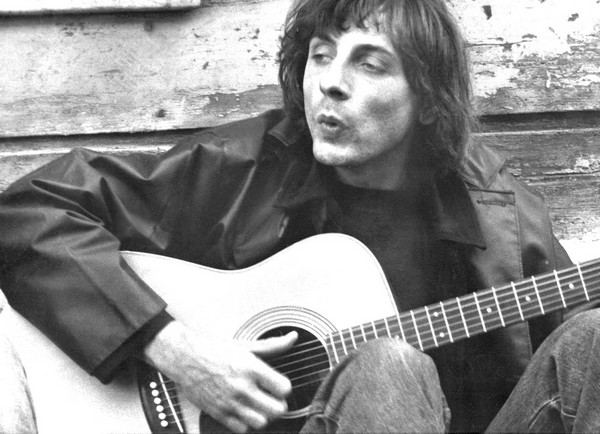
Merde. Pour un moment j’ai pense que j’avais trouve mon viel ami de quelques jour, Jean Paul Boissier. Mais, peut etre il est mort.
Back in the mid-70’s I was living in a crumbling Civil War era mansion with a lot of people, so things would occasionally happen in spite of my near autistic state. (I still live in this house in my dreams, trying to reconcile the background knowledge that we were driven out when it was torn down for OSU hospital parking space.)
Somehow, we ended up with a hitch-hiker from France staying with us for awhile. Why he was in Columbus, OH I’m not sure, but he found the right place if you had to be there. Turned out he was a songwriter, and at some point he undertook to teach me a couple of his songs. I still have them as they were written down and annotated in an old notebook, which I have to search through all my old notebooks to find whenever I try to learn them again. Somehow, between his very little English and my even smaller French he explained most of the images to me. Ah, je vois, ce n’est pas une lyric ordinaire. It took some similes and hand gestures, vraiment.
J’ai mis le feu, I set the fire, you know, the fire in the skull, like when you get sick… faiset mes poubelles, you know, garbage, [gestures of digging through something with one’s hands.]
J’ai mis l’feu by PaulBoissard
the other song: Lili Boule de Gomme
I guess that took up most of our indoor time, I don’t think I ever got to teach him one of my songs. Well, I hardly could teach them to myself around then. I don’t remember much else about his visit. Some black hashish rolled with tobacco, some walking in the sunshine in the big field behind the Hospital Cafeteria, some passing the guitar back and forth, some big smiles.
I proclaimed my intention to write an English translation of the songs and he was all for that, then he could be a big hit on two continents. But, he didn’t keep in touch and I didn’t know how to reach him. I always pictured myself going to France one day and looking around and there he would be playing on a street corner. I let the time pass as if shutting my eyes tight enough would leave me where I was with all possibilities still intact. A couple years earlier, I would have just grabbed my backpack and hitched along.
I did end up learning and sometimes performing that one of the two songs, and finally a couple decades later I achieved a singable English version. Well, I guess I’m still working on it. Not quite satisfied. In recent years I looked for him on the internet a few times, with no success. Last night (early this morning) I was laying in bed sleepless again, and a long FaceBook chat in French with another non-French speaker led to my thinking about the song, failing to remember all of either the French or the English version. After a few hours I got up again, opened a beer and put the entire first line of the song into the Google box and there was a video result right at the top of the page. There could be a lot of “mis le feu” songs I supposed, but in the summary I could see the lyrics going on… those same ones that I thought I might be the only one who knew. …le seule solution…” It was a slightly different version, in 4 instead of waltz time, piano instead of guitar… but this is the song. (not really a video, just an audio recording with a picture of a fire to accompany it.) And that led to a whole page of videos of songs by Paul Boissier. (I guess they dropped the “Jean” at some point.) Damn, I thought, the sucker went and became functional in society. This led to finding both a Facebook and MySpace page, and I was excitedly getting ready to write to him when I read in the blurb on one of them something to the effect of (loosely tryanslating and from memory): “Gone too soon, before the inevitable national acclaim. They went on: Paul Boissard a marqué toute une génération de musiciens et poètes picards.”
I also found video and articles about a 20th anniversary celebration in 2007 for a collective cabaret named La Lune des Pirates, after one of Jean Paul’s songs. One of the nights of the anniversary was a Tribute to Paul Boissard. I guess that he had but to personally hand a song to the right person (here and there) to have it cared for and kept alive. No record company or publicity machine required.
I can’t find info on why he may have died. Later, I found on the main page of his DailyMotion site where they say he died some 20 years ago. This may have something to do with why the photos look pretty much like I remember him. But, I guess he made his mark. He lived.
et moi? “Maintenant, je reve sur des cendres… “-
Paul Pages:
http://www.correzitude.fr/GUDI/ILNOUSPROMENESURLAGUITARE.html
http://www.dailymotion.com/PaulBoissard
Listen Here
Night Music clips on yootoob
Surprising music show, maybe the coolest ever, even. And in the ’80s, of all places. I just happened to think there might be better clips on the internet by now than I could find on my couple of moldering video tapes. And sure enough, here’s
one treasure trove:
And the preview, some Funky Chicken. (I thought Rufus was my ‘celebrity sharing a birthday’, but all his bios I’m seeing now say a day earlier). But there’s so much more. Pharoah Sanders. NRBQ. Loudon. Toots. Bootsy. And, People who weren’t even alive.
Happy Birthday, Pete
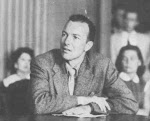

Pete testifying:
The testimony:
http://www.peteseeger.net/HUAC.htm
Here’s one place playing some music for the occasion:
http://www.downhomeradioshow.com/2009/05/pete-seeger-turns-90-happy-birthday/
I don’t have the time or strength to write the book on Pete right now. Heck, that would mean catching up with what he’s been up to, when there’s no one who could even keep up with him. There was a very nice biography on him broadcast on PBS last year, and it showed me many things about his life I had either never heard or forgotten over the years. I guess he never much focused on telling us his own story, except as it related to his telling of other people’s stories, and their telling of their own. By the end of the movie, I was saying, “I take back any of the nasty things I’ve had to say about Pete over the years.” Not that I ever stopped being his fan, but I certainly saw some weaknesses between when I got into the whole earlier folk movement in my early teens, and when I learned so much more about the more rootsy original versions that inspired it. Not that I would take kindly to any ignorant punk putting him down. But, sure, Pete’s blues weren’t that bluesy. His easy-going approach to other languages turned ‘mbube’ into ‘wimoweh’ in most of the world’s mind. he would choose ideology over aesthetics repeatedly.
Still, I see now, he is authentic as any of those sources. He has been the most whatever the heck he is that anyone could possibly be. He got every drop out of it. Unflagging effort, unsullied virtue, untiring seeking and sharing. Love, peace, justice, universal brotherhood of man. School drop-out, hobo, protester, cabin-building rural independant… if it weren’t for his shunning of drugs, alcohol and free sex he would indeed be the prototypical hippie.
One of the most amazing and mysterious things about his history is his effect on popular culture. he has spent most of his life not only not pursuing fame and commercial success, but attacking the very concepts. And yet, he keeps coming back to the ‘top of the charts’ decade after decade. Talk about the weeds cracking the sidewalk.
I guess there should be some mention of the star-studded spectacular, though I’m not that hot on it. He’s spending tonight at Madison Square Garden with Bruce Springsteen and Eddie Vedder, etc. and certainly not that happy at the prospect. “I’ve already had too much publicity”, he says. But, it’s going to raise a lot of money for his pet project of keeping a sloop sailing the Hudson, raising awareness for its’ cleanup. He had this idea a long time ago; and it happened.
